

Customers
Customers of your SSG instance
A customer is the organisation you bill and credit. One or more SMPP accounts belong to that customer and are what their applications (or txtConsole) use to send and receive SMS. Each SMPP account uses a service, which supplies the pricing plan and routing profile.
Customers connect using the customer endpoints.
A walkthrough is in the Customers tutorial.
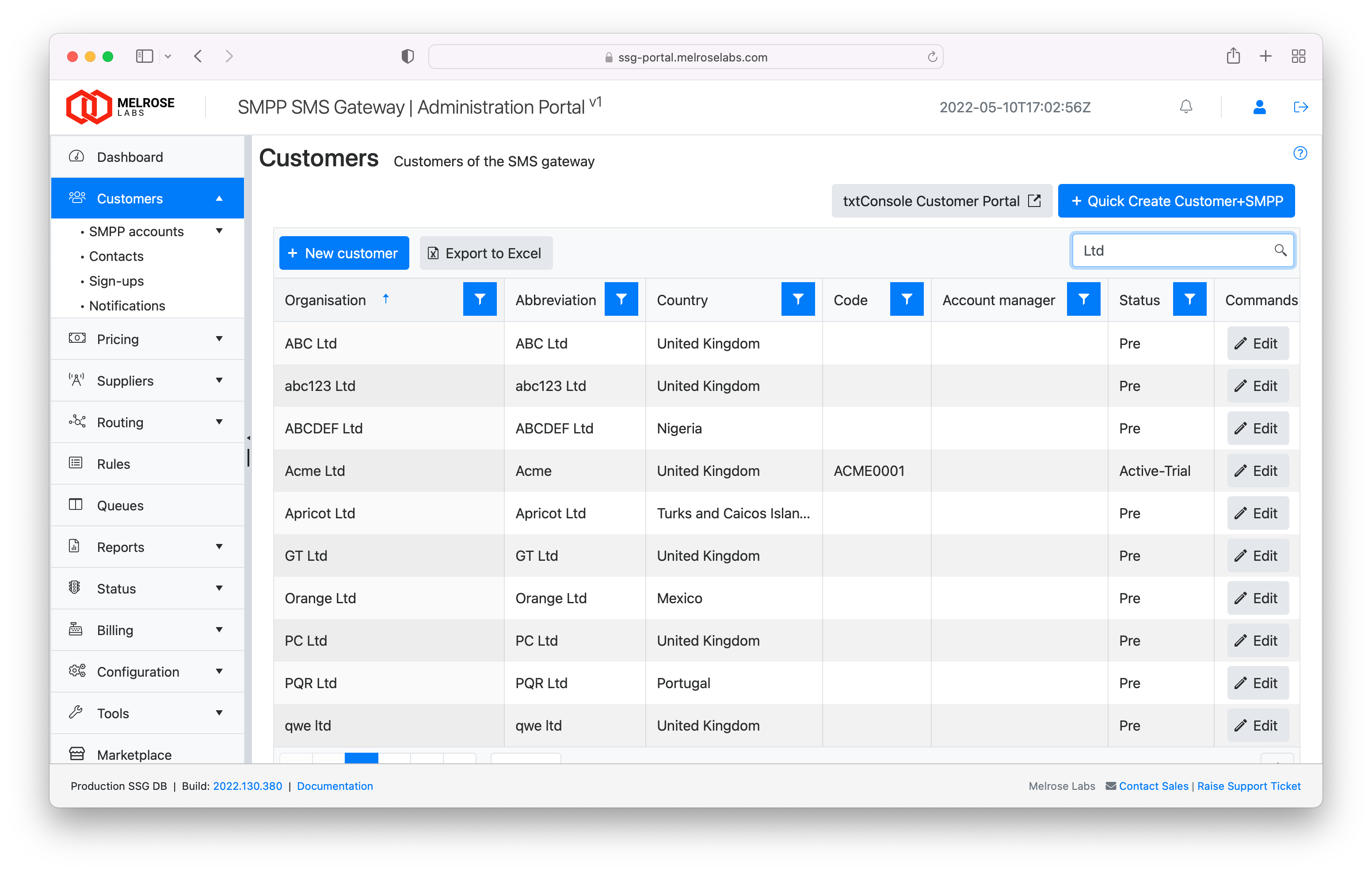
Customers section
The Customers section has:
| Page | Purpose |
|---|---|
| Customers | Customer records |
| SMPP accounts | Accounts that bind and submit. See SMPP accounts |
| Contacts | People at each customer, including who receives pricing and invoices |
| Sign-ups | Public sign-up requests waiting for approval |
| Notifications | Queued pricing-change emails. See Pricing |
Tables support search and Excel export. Customers > SMPP accounts and Customers > Contacts also have a customer filter.
The customer and SMPP dialogs warn if you close with unsaved changes (badge on the footer, confirm before discard).
Add a customer
The fastest way to add a customer and their first SMPP account is Quick Create Customer+SMPP.
Quick Create Customer+SMPP
- Go to Customers.
- Click Quick Create Customer+SMPP.
Customer
Enter Organisation and Country.
Set Initial credit and Currency:
- A real currency (GBP, USD, EUR, and others) creates a monetary balance.
- None creates an SMS-credit balance. The credit value is then the number of messages the customer can submit.
Contact
Enter Name, Email and Mobile (international MSISDN, for example +447700900123). The email is used if you send the SMPP configuration.
SMPP
Select the Service. Optionally enter CUG Mobiles (comma-separated MSISDNs). If you later enable Use CUG on the account, the customer can send only to those numbers.
Choose whether to email the SMPP configuration to the customer contact and/or the account manager.
Click Setup. The new customer appears in the table.
New customer (no wizard)
- Click New customer.
- Complete Company and Billing.
- Click Save.
- Add an SMPP account from Customers > SMPP accounts. See SMPP accounts.
Edit a customer
Double-click the row, or click Edit. Click Save after you change fields.
Company
| Field | Description |
|---|---|
| Short name | Name used in the portal |
| Legal name | Legal organisation name |
| Country | Country of the organisation |
| Company reg no | Company registration number |
| Record created / Ceased date | Read-only |
| Account status | Live, held or closed. Archiving sets a closed status. Pricing-change emails skip closed accounts |
| Account manager | Portal user responsible for the account |
Billing
Complete this tab before you raise invoices. See Billing.
| Field | Description |
|---|---|
| Tax code | Tax code for the account |
| VAT reg no | VAT / sales tax ID shown on invoices |
| Charge VAT | Whether VAT is charged on invoices |
| Account code | Short unique code (for example ABCCORP331) used on invoices and for matching to your accounting system |
| Payment terms (days) | Used to calculate the invoice due date (invoice date plus this number of days) |
| Send invoices to (email) | Type each address and press Enter or comma |
| Send invoices to (physical) | One address line per row. Shown on the invoice |
| Hold generated invoices | New invoices for this customer are created on the Held tab |
| Hold reminders/suspensions | Automatic payment reminders and suspension notices are not sent |
Balance
The balance sits on the customer, not on each SMPP account. Every SMPP account of that customer draws from the same balance.
The tab shows the current currency and amount, and a recent change list. Add or remove credit in Billing > Account balances. See Account balances.
Balance warnings
Warning emails can be sent when the balance crosses an upper or lower threshold.
- Enter Email address (int.) — one or more internal addresses, comma-separated.
- Enter Upper threshold and Lower threshold. The lower value must not be greater than the upper.
- Click Update.
Leave a threshold blank to clear it.
Other
Customer API ID is assigned after save. It is read-only and identifies the customer in Management API requests.
Contacts, SMPP, Invoices, Reporting, Notes
These tabs show a view of the same data you manage elsewhere:
- Contacts — see Contacts
- SMPP — see SMPP accounts
- Invoices — invoices and payment history. See Billing
- Reporting — volume for this customer. Instance-wide reports are in Reports
- Notes — free-text notes. Sending a pricing-change notification also adds a note
Contacts
Go to Customers > Contacts, or use the Contacts tab on the customer dialog.
Click Create contact. Filter the grid by customer when you need a single organisation.
Main
Name, email, mobile and other telephone. Email is required (used for pricing and invoice mail when those notices are ticked).
Notices
| Notice | Receives |
|---|---|
| Pricing | Current rate sheets and pricing-change emails |
| Invoices | Invoice emails |
| Operations | Operational notices |
Roles
Mark primary or secondary commercial, billing and technical contacts.
Sign-ups
Customers > Sign-ups lists requests posted to a service that has public sign-up enabled. See Public Signup.
Outstanding requests show organisation, contact, service, CUG mobiles and whether the organisation already exists.
- Provision — opens Quick Create Customer+SMPP with the sign-up fields filled. Initial credit and currency come from the service provisioning defaults when they are set.
- Reject — marks the request processed and does not create an account.
The lower table is the full history of received sign-ups.
Notifications
Customers > Notifications is the queue of pricing-change emails generated when you approve a batch in Pricing > Pricing changes. Click Send notifications to send them.
See Pricing.
Do Not Disturb
A Do Not Disturb (DND) list rejects customer submit_sm to listed MSISDNs (ESME_RSUBMITFAIL / 0x0045).
- Import and manage the list in Configuration > Firewall > DND (merge a file with the existing list).
- Enable the list on an SMPP account with
"use_dnd_list":truein the account options JSON. See SMPP accounts. - DND Service API keys are created in Configuration > Company (enabled by default on a new key). On-premises instances can query a number with MSISDN in DND.
Archive a customer
Use Archive only when there will be no further activity.
The platform rejects new binds and stops submission on all of that customer's SMPP accounts. The customer and those accounts are removed from the rest of the portal.
Related
- SMPP accounts — bind, submit, security, webhooks, CUG
- Account balances — credit, Prepay / Postpay, currency
- Billing — invoices, statements, recurring
- Services — plan + routing on each account
- txtConsole Portal — customer-facing portal
Updated about 2 months ago